
Raw Material Preparation: Ensuring Consistency for the Wooden Pallet Production Line
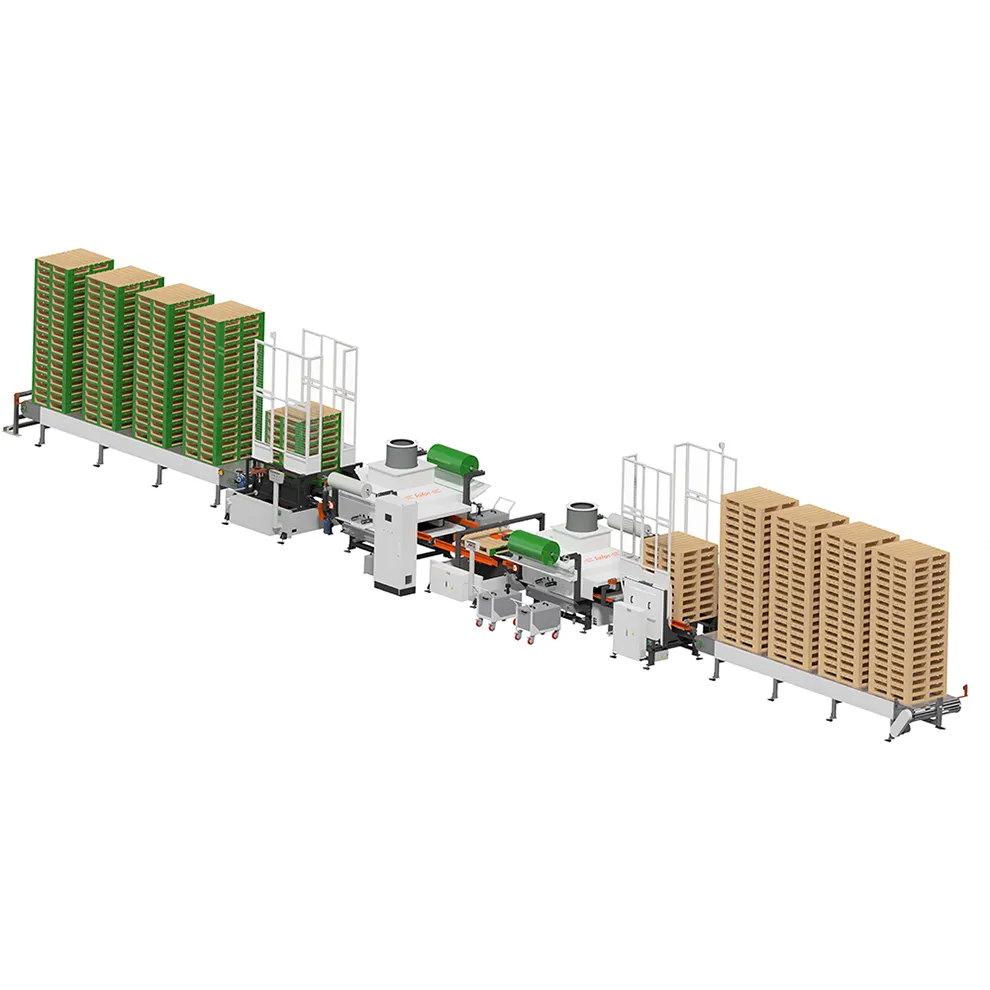
Precise raw material processing establishes the foundation for durable, specification-compliant pallets. This phase eliminates variability that compromises structural integrity downstream.
Debarking and Sawmilling: Standardizing Log Input for Yield and Defect Control
Modern industrial debarkers take off bark really well while keeping wood waste to a minimum. They actually boost the amount of usable lumber by around 10% or so when compared with old fashioned hand methods. After debarking, computer controlled sawmills slice up logs into properly sized pieces with pretty tight tolerances, roughly plus or minus 1.5 millimeters. These machines have laser sensors that spot knots and weird grain patterns in the wood. The extra attention to detail means fewer weak spots end up in things like deck boards and structural supports, which makes everything stronger overall. Most big manufacturers are following sustainable forestry guidelines these days too. About three quarters of them source their timber responsibly according to these environmental standards.
Drying and Moisture Management: Preventing Warping and Nail Pull-Out in Final Pallets
When wood gets dried in kilns, it brings down the moisture level to around 19 to 23 percent MCV, which happens to be really important for keeping things from warping over time. If the moisture levels go off track, all sorts of problems pop up like warped boards, nails coming loose when weight is applied, and even mold growing in damp conditions. These issues aren't just annoying they actually create serious safety concerns and can lead to compliance headaches too. Keeping tabs on humidity while storing materials helps maintain that balance point where everything stays stable. According to recent findings from the Pallet Industry Report back in 2023, proper monitoring cuts down on corrosion problems with fasteners by about 40%. For anyone dealing with exports, this kind of control isn't optional but absolutely necessary if they want their pallets to meet those strict ISPM-15 standards for plant health requirements across borders.
Precision Cutting and Component Sizing in the Wooden Pallet Production Line
Optimizing Kerf Loss, Tolerances, and Nesting Algorithms for Maximal Board Yield
How accurately we cut materials makes all the difference when it comes to how much gets wasted. The kerf width basically refers to what gets lost in the process when saw blades go through the wood. Now, there's this advanced nesting software that figures out where to place each board on raw lumber so there's minimal space between them. And guess what? It still keeps everything within those tight ISO standards, around plus or minus half a millimeter. For most woodworking shops, this approach cuts down their yearly wood waste somewhere between twelve and fifteen percent. That actually adds up to about two hundred extra pallets worth of product every single month. And let's not forget about real time laser calibration either. When making deckboards and stringers, having components that are consistently sized matters a lot. Without proper alignment, structures just aren't as strong under weight loads, which nobody wants.
Chamfering, Trimming, and Edge Conditioning for Stackability and Forklift Safety
Workplace safety gets a real boost from post-cutting treatments that make everything run smoother. These days, most warehouses use automated routers to put those 45 degree chamfers on pallet corners. This simple change cuts down on splinters that cause around 17% of all hand injuries according to OSHA reports from last year. Warehouse managers know firsthand how frustrating those sharp edges can be when loading and unloading goods. The rounded corners let forklifts maneuver more easily between pallets too, which means fewer accidents when moving heavy loads across the floor. When it comes to precision trimming, getting pallet heights consistent within just 1mm makes all the difference. Stacks can safely reach six pallets high without tipping over, and they fit perfectly into automated storage systems where even slight variations in size would cause problems with robotic handlers constantly misreading measurements.
Automated Pallet Assembly and Nailing: Integrating Speed, Strength, and Compliance
Nail Pattern Engineering: Matching Load Requirements with ASTM D1185 and ISO 8611 Standards
The way nails are placed makes all the difference when it comes to how strong pallets are against moving weights. Modern automated systems handle where these fasteners go according to standards like ASTM D1185 and ISO 8611. These machines actually calculate just how many nails should be at each connection point depending on what kind of load the pallet needs to carry and how that weight spreads across different areas. Take a standard 2000kg block for example most manufacturers use spiral arrangements with around 12 nails meeting at every spot where boards cross. The robots controlling this process can place nails within half a millimeter of their intended position. This level of precision gets rid of the random variations people tend to make when nailing by hand. As a result, these pallets perform much better during those tough ISTA 6-SAMSCLUB tests that simulate real world shipping conditions.
System Selection Guide: ROI Comparison of Manual, Semi-Automatic, and Fully Automatic Nailing Lines
High-volume operations gain the strongest ROI from fully automatic systems—delivering 60–75% higher throughput while integrating seamlessly with upstream cutting stations via PLC-controlled material flow. Semi-automated lines suit mid-volume producers seeking labor savings without full conveyor reconfiguration. Manual setups remain practical only for highly customized, low-volume production (<15,000 pallets/year).
FAQ
Why is debarking important in pallet production?
Debarking is crucial as it maximizes the amount of usable lumber, reduces wood waste, and enhances the overall strength of the pallets by minimizing defects.
What moisture content is ideal for kiln-dried wood?
The ideal moisture content for kiln-dried wood in pallet production is between 19 to 23 percent, ensuring stability and preventing warping or mold growth.
How does nesting software minimize wood waste?
Nesting software determines optimal board placements on raw lumber, which minimizes the space between boards and complies with tight ISO standards, significantly reducing wood waste.
What are the benefits of using automated routers for chamfering?
Automated routers reduce splinter-caused injuries, enable smoother forklift operations, and enhance workplace safety by chamfering pallet corners to 45 degrees.