
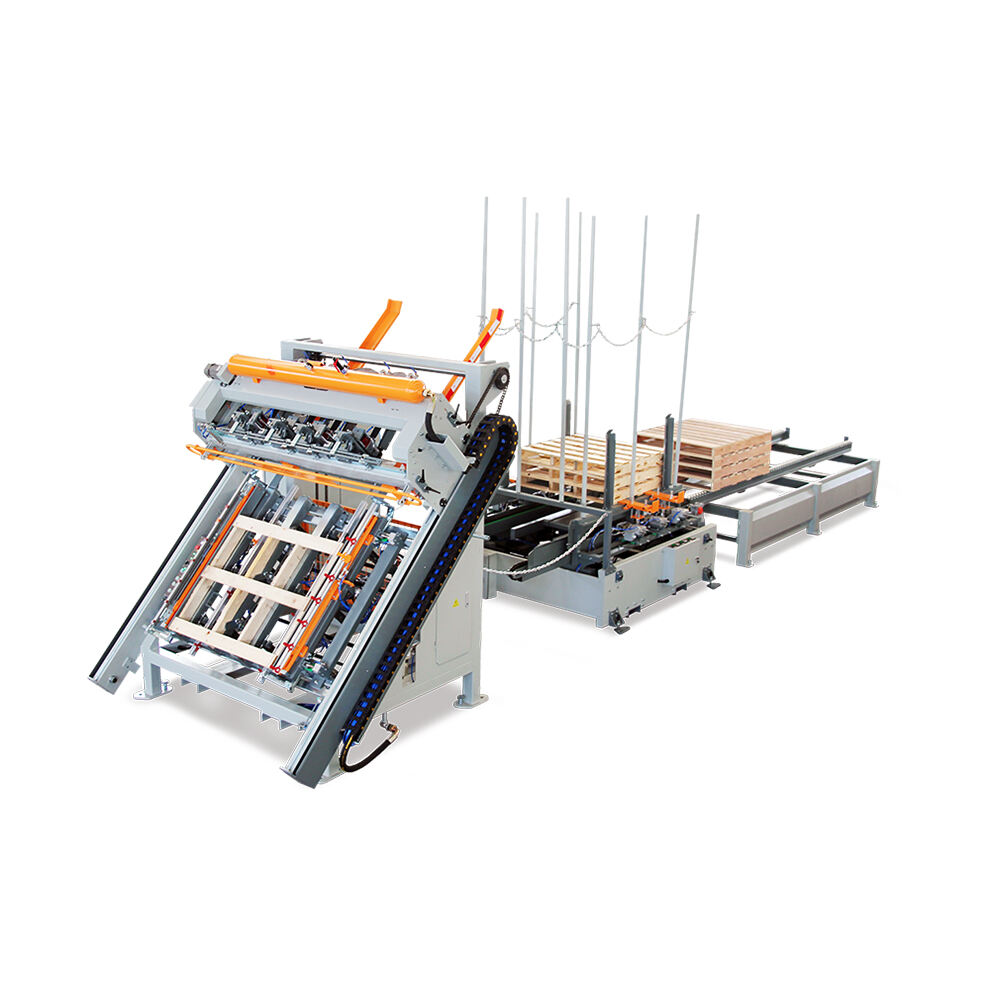
Why an Automatic Pallet Making Machine Is the Strategic Core of Your Factory
Key capabilities: High-precision nailing, automated assembly, and consistent surface finishing
When factories bring in automatic pallet making machines, they're basically rewriting the rules of how pallets get made. These machines take over from those error-prone manual processes where workers would struggle with consistency. The servo driven nailing systems are pretty amazing actually, placing each fastener within millimeters accuracy so we don't end up with those wobbly joints that just fall apart under load. What really makes these machines stand out is how everything works together seamlessly. Boards get fed into position, aligned properly, then nailed all in one smooth motion. This cuts down on production time significantly, maybe around 40% faster per pallet, while keeping those deckboards spaced just right throughout. And let's not forget about the finishing touches either. Pressure rollers flatten out any irregularities and sanding belts give surfaces that clean finish required for meeting ISPM 15 standards when shipping overseas. Most plants that switch to this kind of automation find themselves needing far fewer workers, somewhere around 85% reduction in staff, and they can produce four times as many pallets each day compared to what was possible manually. Of course there are always exceptions depending on specific factory conditions, but generally speaking these machines represent a game changer for the industry.
Critical integration factors: Timber feed compatibility, PLC control systems, and scalability for 500–5,000 pallets/day
Getting these systems up and running successfully depends on three main technical elements working together. The first is how well they handle different types of wood. These machines can work with both hardwood and softwood blanks that vary in size by around 3mm either way. They don't get stuck or need someone constantly watching them when there are slight differences in the material dimensions. Next comes the brain of the operation - those PLC control systems. They manage everything from figuring out which way boards are facing to changing nail depths based on what moisture sensors detect in real time. Operators can fix problems through touchscreens that aren't too complicated to use. And finally, the whole system is built in modules so companies can grow as needed. Want to go from making 500 pallets a day to 5,000? Just add more conveyor belts for feeding materials or install automatic stacking units. This flexibility really matters when demand goes up seasonally. Companies running high volume setups typically see their investment pay off within 18 months if they're operating at about 70% capacity most of the time.
End-to-End Automated Production Workflow: From Raw Timber to Finished Pallets
Pre-automation essentials: Kiln drying, moisture control (<20% MC), and graded timber sourcing
Getting timber ready properly isn't something that can be skipped if we want stable, productive automation systems. The kiln drying process needs to bring moisture levels down under 20% MC to stop problems like warping and joints coming apart when things get assembled. Most of the time, this takes around two to three days but varies based on what kind of wood we're dealing with and local climate factors. At the same time, sourcing timber that's been properly graded makes all the difference for consistent materials. Good suppliers will check every batch against those JAS or ISO 3394 standards looking at how stable dimensions are and how many defects exist. When both these prep steps happen right, factories see fewer machine jams later on and waste drops somewhere between 18 and 22 percent compared to working with raw, untreated lumber. That kind of improvement really adds up over time.
Seamless line integration: Sawmilling – CNC blanking – robotic transfer – Automatic Pallet Making Machine
Today's pallet manufacturing processes typically involve four main steps working together seamlessly. First up are optical scanning sawmills that measure raw logs and cut them into deckboards and stringers while analyzing the wood grain as they go along, which helps get the most out of each log. Next comes the CNC blanking machines that slice all parts according to specs with about half a millimeter accuracy. After that, robotic arms grab these pieces and send them along conveyors toward what we call the heart of the operation - the Automatic Pallet Making Machine. Once there, everything gets nailed together using pneumatic tools guided by lasers, and finished surfaces within just over a minute per pallet. The whole system runs nonstop without any human hands involved, resulting in consistent quality around 98% of the time, and factories can crank out over 500 pallets every single day this way.
Startup Investment, ROI Timeline, and Labor Optimization with Automation
Realistic 2024 cost breakdown: $180K–$450K for turnkey Automatic Pallet Making Machine + conveyors, stackers, and QA stations
Setting up a complete automated pallet production line demands serious financial commitment upfront. The full package deal typically includes an Automatic Pallet Making Machine, conveyor belts for feeding timber, stacking machines that work automatically, plus stations where quality checks happen. Prices for these systems ranged from around $180k to nearly half a million dollars as of 2024. Why such a big difference? Well, smaller operations might start with basic modules capable of making about 500 pallets each day. But bigger facilities looking at higher volumes will need advanced setups with fancy PLC controls and precise nailing tech to hit targets of 5,000 units daily. Don't forget extra costs either. Most plants end up spending another 10 or even 15 percent on site changes and safety features alone. And what do manufacturers get for their money? According to industry stats, these automated lines cut down manual labor by roughly 70%. Plus they ensure every single pallet meets consistent standards regarding size, strength, and overall finish quality throughout production runs.
ROI calculation: Payback in 14–22 months at 70% capacity utilization; labor shift from manual assembly to machine supervision & logistics
Automation delivers measurable financial returns within 14–22 months when operating at 70% capacity utilization. This timeline incorporates three verified drivers:
- Labor restructuring, reducing manual assembly roles by 60% and redeploying staff to machine supervision, logistics coordination, and preventive maintenance
- Throughput efficiency, delivering 500–5,000 pallets/day with 30–50% fewer dimensional or assembly errors
-
Resource optimization, cutting material waste by 18% via CNC-driven cutting algorithms and consistent nailing patterns
At a typical gross margin of $2.50–$4.00 per pallet, full equipment cost recovery occurs within 22 months. Post-payback, facilities report 40% higher gross profits–driven by labor reallocation, reduced rework, and predictable output quality. Sustained gains depend on structured operator training and proactive maintenance protocols.
Navigating Operational Trade-offs: Automation vs. Customization Flexibility
Automation brings incredible efficiency but creates a tricky choice between mass production standardization and custom order flexibility. Fixed automation works great when making thousands of identical pallets day after day with little need for human intervention. However, changing things up for different sizes or special features often means shutting down operations for several days straight. Flexible automation solves some of these problems through programmable controls and interchangeable parts, allowing quicker switches between different product specs. Of course there's a catch - these flexible systems typically cost 30 to 50 percent more initially and demand higher skill levels from technicians. Most manufacturers find themselves somewhere in between depending on what kind of business they're in. Big distributors focused on volume usually stick with fixed automation because it just gets the job done faster and simpler. Companies working in tight regulation environments like pharmaceutical manufacturing, aircraft components, or expensive electronic assemblies generally need the adaptability that comes with flexible automation systems to meet all those strict quality requirements across varying specifications.
FAQ
What are the main advantages of automatic pallet making machines?
Automatic pallet making machines offer improved precision, reduced labor costs, higher output, and consistent quality, streamlining the pallet production process significantly.
How do automatic pallet making machines handle different wood types?
These machines are compatible with both hardwood and softwood, adapting to variations in size and moisture through advanced PLC control systems.
What is the typical ROI period for setting up an automatic pallet-making line?
The ROI for a fully automated pallet production line is generally between 14 to 22 months, provided the system is utilized at about 70% capacity.
Can these machines be scaled up for increased production needs?
Yes, the systems are modular, allowing for scalability from 500 to 5,000 pallets per day, catering to seasonal demand spikes.
Is it possible to customize pallets using automation?
While fixed automation excels in standardization, flexible systems are available but come at a higher initial cost and require skilled technicians for adjustments.
Table of Contents
- Why an Automatic Pallet Making Machine Is the Strategic Core of Your Factory
- End-to-End Automated Production Workflow: From Raw Timber to Finished Pallets
- Startup Investment, ROI Timeline, and Labor Optimization with Automation
- Navigating Operational Trade-offs: Automation vs. Customization Flexibility
-
FAQ
- What are the main advantages of automatic pallet making machines?
- How do automatic pallet making machines handle different wood types?
- What is the typical ROI period for setting up an automatic pallet-making line?
- Can these machines be scaled up for increased production needs?
- Is it possible to customize pallets using automation?